
 Remotion
 HyperFrames
MOTION.md What is this?
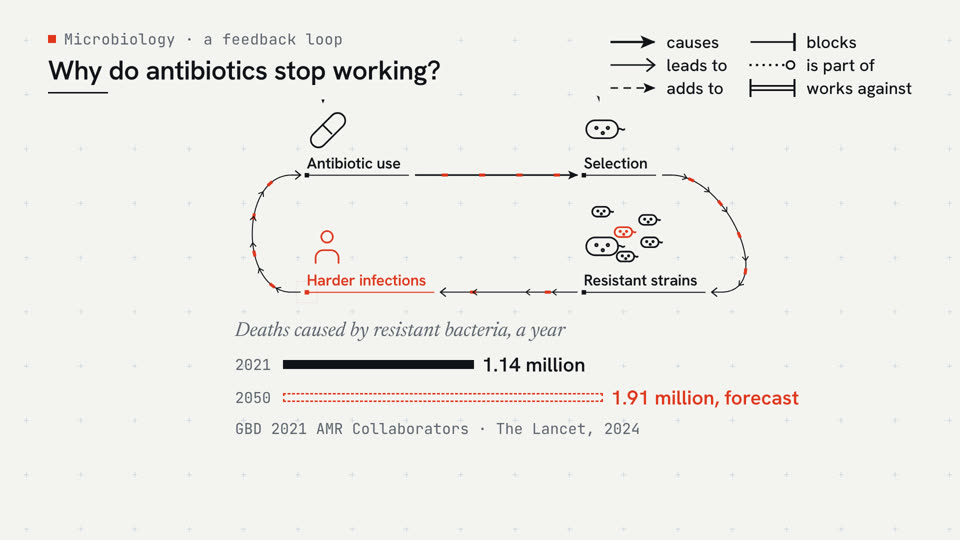
Raw · GitHubA concept map set in type on a cool layout sheet: each term stands on its own underline, which runs on as the line to the next term, drawn to say the relation.
Essence, and what it is not
- Every term is typeset on a rule; its lines leave and arrive along the rule, so a relation reads as the underline running on.
- The stroke is the relation, never the colour: solid arrow causes, dashed contributes, chevrons lead to, dots to a ring are part of, a T-bar blocks, a double line opposes.
- A verb sits in a gap cut in its line, in italic.
- Pictures before words: a line pictogram over a word or two, acting out what is said; few glosses.
- A line comes before the term it reaches. One red for what matters now.
Closest is Lab Notebook, handwriting and drawings on squared paper; here words are typeset, lines ruled, and what is drawn is relations. Not Evidence Board (no cards, pins or thread), not a mind-map app (no bubbles, radial branches or colour coding).
Ground and material
sheet.tsx: a cool off-white sheet (bg) with a faint cross every 160 px (faint) under one camera, between the running head (y 200) and the captions (y 900). Rules 3 px, 6 for an event, doubled for a root cause. A term may be a large pictogram (kind: picture) that multiplies, bursts, spins, beats or fills (act); carry a small one, a framed image or ruled items; be a figure or a quote; or be struck out.
Colour roles
text: every term, rule and line.muted: glosses, indices, sources.border: a dimmed term.op: the one red: the active term or line, a root tab, a bracket, a share's heavy run, a chart's marked bar.data: figures, in ink.panel: the locator's card.grad,good,bad,warnare unused: kinds are told by stroke.
Type and captions
Hanken Grotesk (sans) for terms (46 to 80 px) and figures; Newsreader italic (display) for glosses and verbs (40 to 42); JetBrains Mono (mono) for indices and sources. Chinese: Noto Sans SC terms, Noto Serif SC 500 upright glosses, broken between words, a thin space beside Latin and digits. The caption sits on the sheet: Hanken 36 with a short red rule at its left.
Motion
Grow the map with grow, a step per term on its word: the line runs out with a red nib (0.8 to 1.5 s), its verb appearing as the nib passes; the term's rule runs out, its pictogram draws stroke by stroke, the word stands, then it acts. A new cause is reached by a line run back out of the map. A flow line carries marks along it. Views change over 1.2 to 1.8 s; riding a line the crosses streak. Figures count up; units and bars draw in turn. Nothing bounces.
Composition and framing
Let the map lay itself out (flow, wrapped into rows; down; cycle), and vary it from map to map; beside, rank, order, x and y last. Frame shots with views (and grow for what stands beside terms), never a computed camera. Under zoom 0.8 only terms and lines show. A condition sits above the stage it feeds, a part below its whole.
Sound
Optional: a tick, a pen line, a marimba.
Components
- compare — Two branches (
react/parts/compare.tsx): Two terms side by side, points under each, joined by one relation; one side marked. Fits: two outcomes of one cause; before and after; two options - data — Ruled chart (
react/parts/chart.tsx): Bars ruled from zero, or one line on a valued scale with a reference mark; an estimate drawn open. Fits: a value and its forecast; a few groups; a series against a target - data — Figure on a rule (
react/parts/figure.tsx): A large figure on its rule beside a term, counted up, its source under it; a share as a heavy run. Fits: what a cause cost; a share of a whole - data — Unit chart (
react/parts/units.tsx): A share as a row of pictograms counted in, the share in red: three in ten without a sentence. Fits: one in three prescriptions; four in five households; nine in ten species - ground — Sheet and camera (
react/parts/sheet.tsx): A cool layout sheet with faint registration crosses, under one camera. Fits: every scene; the map inside is in map pixels - link — Key of relations (
react/parts/key.tsx): A sample of each kind of line the map uses, and what it means. Fits: the first time two kinds of relation meet - link — Relation (
react/parts/relation.tsx): A line run on from a term's rule; its stroke is the relation, its verb sits in a gap. Fits: a cause; a stage turning into the next; a part; a fix that blocks - mark — Bracket (
react/parts/bracket.tsx): A red square bracket along a group of terms, with a short note. Fits: the loop in a cycle; the root causes; the part a fix touches - mark — Pictogram (
react/parts/pictogram.tsx): A large line pictogram drawn stroke by stroke, then acting: multiplying, bursting, turning, beating, filling. Fits: bacteria multiplying; a cell bursting; a machine running; a heart beating; a reservoir filling - steps — Idea map (
react/parts/map.tsx): A map laid out from its terms and relations (flow, down, cycle), grown line before term, under a camera. Fits: a cycle; a chain of causes; a hierarchy; a root-cause review; a process - term — Term on its rule (
react/parts/term.tsx): A term typeset on its rule: with a gloss, index, pictogram (acting), picture or points; a large pictogram, a figure, a quote, or struck out. Fits: a stage; a cause; a person or a place; a count; a failure; a fix - title — Running head (
react/parts/heading.tsx): The map's question at the head of the sheet: a mono kicker by a red square, the title, a short rule. Fits: the question a lesson answers; the incident under review - transition — Locator (
react/parts/locator.tsx): The whole map in miniature, the frame a red box moving over it. Fits: a ride along a line; a close look at a large map
Native moves
- Run the rule on. A term's underline keeps going as the line to the next, its verb in the gap. Fits content like: a stage into the next; a cause and its effect; a decision and its result.
- Ride the line. The camera follows the nib to a term off frame, the locator showing where. Fits content like: a gene making its enzyme; a policy reaching a group; an order passed down.
- Close the loop. The last line returns to the first term, chevrons showing the way round, a bracket naming it. Fits content like: the water cycle; a vicious circle; a feedback loop in a product.
- Name the stroke. Two kinds of relation meet and the key draws each. Fits content like: deep causes and a trigger; parts and effects; help and harm.
- Block the cause. An action sends a T-bar line into the cause it stops. Fits content like: a fix in a review; a vaccine; a law against a loophole.
- A figure on its rule. A large figure stands beside the term it measures, counted up, source under it; or bars rule out from zero, a forecast drawn open. Fits content like: deaths a cause led to; a share that failed; now and in 2050.
- Lay a second sheet. A sheet over the map sets two branches side by side. Fits content like: two outcomes; before and after a reform; two options.
- Pull back to the view. From close in, the camera moves out to the terms now discussed. Fits content like: the whole loop; all causes of an incident.
- Act it out. A pictogram multiplies, bursts or turns as said. Fits content like: bacteria dividing; a cell bursting; a mill.
Avoid: pitfalls
- A verb laid on its line. Fix: give the relation a label; it finds its gap.
- A term standing before its line. Fix:
grow. - Every term red. Fix: one red per thought.
- A rounded figure, or a bar not from zero. Fix: values as said, sourced; bars from zero.
Freedom in each work
Three structures: a cycle, then broken by a fix; a root-cause review from the incident back to the root, ending on its fixes; a cascade read top to bottom, then two outcomes compared.