
 Remotion
 HyperFrames
Essence, and what it is not
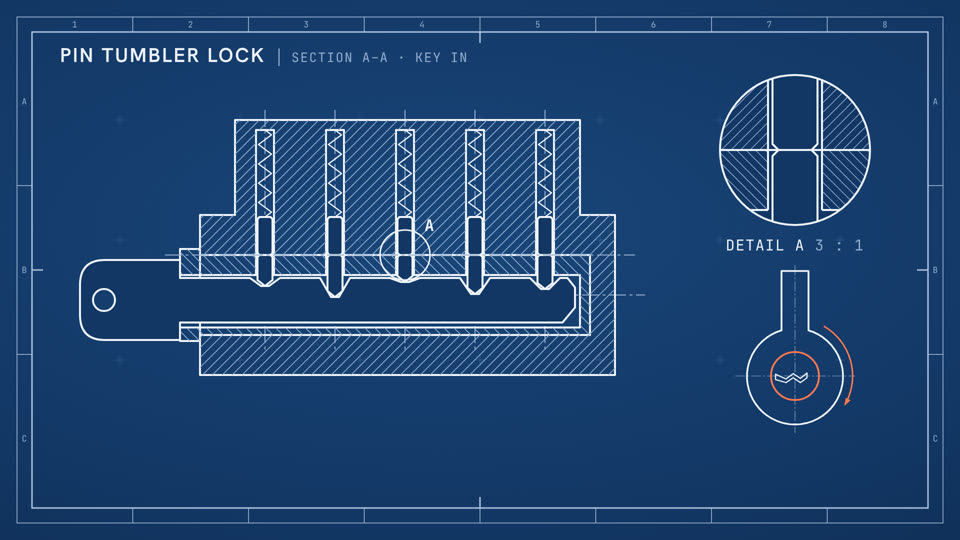
- A deep-blue drawing sheet with a ruled frame, zone references and centring marks; everything is a drawing on it, in white line.
- Lines are ruler-true and have meanings: heavy outlines, lighter detail, thin dimensions, leaders and hatching, chain centre lines, dashed hidden edges.
- Drawn in drafting order as it is explained, a plotter's nib at the head of each line.
- The conventions move: dimensions measure out, cuts sweep and hatch, details lift out, assemblies explode and turn.
- One warm colour, vermilion, for the size being said or the cut being made.
Not a lab notebook (no paper, no hand: every line is ruled), not a sci-fi HUD (no glow, no scan lines, no spinning wireframes), not an aged blueprint (no stains, stamps or hand lettering).
Ground and material
sheet.tsx draws the ground edge to edge: a deep blue sheet (panel, lit toward the middle with panel2), a double frame (border) with zone numbers 1–8 and letters A–D between the rules, centring marks at the middle of each side, faint registration crosses (faint) every 240 px, and the subject in capitals at the top left with the view beside it. SHEET.area (x 120–1800, y 150–870) is where drawings go: inside the frame, below the title, above the caption. The sheet never moves; a camera move scales and shifts the drawing's parts inside it.
Colour roles
text: the line work and lettering.muted: thin lines (extension lines, leaders, hatching, centre and hidden lines) and quiet lettering.grad(vermilion): the one thing the sentence measures or cuts: a dimension, the sweeping cut, a turn. One at a time.border,faint: the frame and the registration crosses. Never drawn with.panel: the sheet, and the fill that lets a part hide what is behind it;panel2: the walls of a turned solid.
Type and captions
JetBrains Mono (mono), capitals with open tracking, letters the drawing: names on leaders 34 px, dimensions 30 px, a view's scale 30 px, the sheet's note 26 px. Hanken Grotesk (display, sans) for the subject at the top left (40 px, 600, tracked) and view titles (34 px, double-underlined). Chinese: Noto Sans SC. The caption is Hanken Grotesk 34 px in a dark blue band with a thin pale rule on its left, above the frame's bottom rule.
Motion
A line draws at the speed of a ruled stroke, eased at its ends (0.6 to 2.5 s a layer), its nib leading; layers follow drafting order. A dimension: extension lines, then the line runs out from its middle while the figure counts up, then the arrowheads. A section: a vermilion edge sweeps across the material (1 to 1.4 s) and leaves hatching. Lettering types left to right. Parts that move (pins, a key, an exploded part) arrive fast and settle with a small overshoot, A camera move is slow and eased (about 2 s, ease in and out); a pan between two views takes 0.8 s out and 0.9 s in. Nothing drifts or pulses; a finished drawing holds still.
Composition and framing
One view fills the drawing area, or two views side by side projected from each other (a section and an end view at the same heights). Names sit on short leaders outside the outline, on the side with room; dimensions stand off the part on the side away from its other lines. A new idea about the same object adds to the same view, so the board accumulates; a different view is reached by gliding along the sheet. A detail is lifted out into empty sheet beside the view it comes from.
Sound
Optional: a faint pen tick, a soft click as a part settles. No music is part of the motion.
Components
- data — Dimension (
react/parts/dimension.tsx): A size measured out as it is said: extension lines rise, the line runs out to its arrowheads, the figure counts up. Fits: a diameter, a gap, a length: any size the narration states - ground — Drawing sheet (
react/parts/sheet.tsx): A deep-blue sheet edge to edge: a ruled frame with zone references, registration crosses, the subject lettered top left. Fits: every scene; a new view changes the note beside the title - link — Detail view (
react/parts/detail.tsx): A small circle on the drawing lifts out and grows into a magnified view, named DETAIL A with its scale. Fits: where two parts meet; a thread, a seal, a tolerance - mark — Cutting plane (
react/parts/cut-line.tsx): Where the object is cut: a chain line through a view, heavy ends, arrows for the sight and a letter at each end. Fits: the plane a section is taken on, before its inside is shown - mark — Section hatch (
react/parts/section.tsx): A solid cut through: a warm edge sweeps across it and leaves 45° hatching. Fits: a housing's wall, a beam, the ground under a foundation - steps — Exploded view (
react/parts/exploded.tsx): An assembly pulled apart along its axis, each part clicking into line; it can tilt into an isometric model with thickness. Fits: what an assembly is made of; the order its parts go in - steps — Line work (
react/parts/line-work.tsx): A drawing laid down in drafting order, a nib at the head of each line: centre lines, outlines, detail. Fits: a mechanism, a beam and its supports, a plan: whatever the explanation draws - term — Leader callout (
react/parts/callout.tsx): A part named on the word: a dot, a leader with one knee, the name on a shelf. Fits: naming a part; a material; a count for a part that repeats - title — View title (
react/parts/view-label.tsx): A view's name under it, double-underlined, its scale beside: SECTION A–A. Fits: telling a section from an outside view; a scale that matters
Native moves
- Measure it as you say it. A dimension's line runs out and its figure counts up to the size on the word. Fits content like: a bore's diameter; the span of a bridge; the gap in a spark plug.
- Cut it open. A cutting plane is drawn on one view, then a vermilion edge sweeps the section and leaves hatching, neighbouring parts hatched the other way. Fits content like: the inside of a lock; a wall's layers; a pipe joint.
- Lift the detail. A small circle is drawn where something is too small to see, then travels out and grows into a magnified view, named with its scale. Fits content like: where two pins part; a thread; a seal's lip.
- Explode it. The parts of an assembly pull apart along their centre line, settle in line, are named, and the view may turn to show their thickness, then back to a flat elevation to measure. Fits content like: a pen; a cartridge valve; a bearing.
- Move with the mechanism. Parts of the drawing do what the mechanism does: pins drop and rise, a key slides in, a plug turns. Fits content like: a ratchet; a gear train; a cam and follower.
Avoid: pitfalls
- Every line one weight: it reads as a diagram. Fix: outlines 4 px, detail 2.5, thin 1.75, centre and hidden dashed.
- Two vermilion things at once. Fix: one per moment; the cut's edge leaves, then the dimension may take it.
- The whole drawing appearing at once. Fix: tween the line work in drafting order over the words that describe it.
- Labels inside a busy section. Fix: a leader out to clear sheet, the shelf away from the drawing.
- Measuring a turned view. Fix: turn back to a flat elevation before a dimension.
- Lines far past a part (hatching a whole box, a magnified drawing hidden by its circle): a line counts where it runs, not where it is hidden. Fix: hatch the material's box; magnify only what lies in the small circle.
Freedom in each work
Each film decides its object, its views, which conventions move, how far the camera goes and the ending. Three far-apart structures: one section built up scene by scene until the mechanism runs; a plan and an elevation of a building drawn in turn, then a detail of the joint that holds it; an exploded view first, reassembled part by part into the working whole.