
 Remotion
 HyperFrames
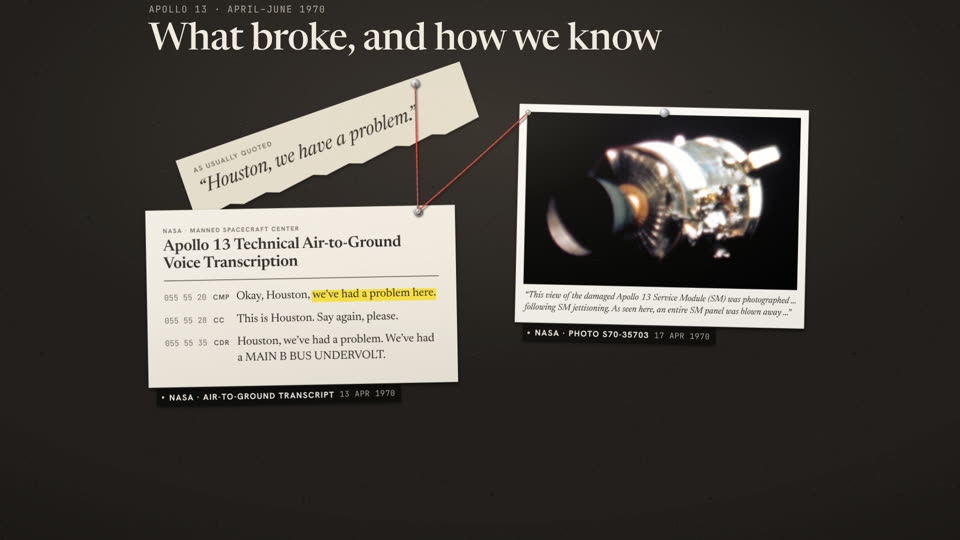
Visual journalism on a dark felt board: the sources themselves, pinned as cards with their source tags; the camera pushes into the original line, a highlighter marks it, and red thread ties the cards into a case.
Essence, and what it is not
- The evidence is the picture: documents, transcripts and photographs in their own words, never paraphrased.
- Every card says where it came from: a dark tag under its edge, holder and date.
- The camera reads: it glides card to card and pushes in until the quoted line fills the frame; a highlighter sweeps it as it is said.
- Red thread is the argument: a link is a thread run pin to pin as it is spoken. What is pinned stays, so the end is the whole case.
Not a detective cork board (no fingerprints, tape, mugshots, stamps or handwriting), not Red Pencil (one sheet marked by a judge), not a slide of quotes, not Screen Desk (one app on a pale desk), not Stage Light (a lit stage of figures).
Ground and material
board.tsx: warm charcoal felt (bg) with a weave and old pin holes, one soft light from above, a vignette; a camera (data-camera) over board pixels. card.tsx: paper (panel), a photo's whiter mount or an aged slip (panel2), a shadow that tightens as it lands, one steel pin (threads end on small tacks), a tag. A claim with no source is a torn slip. Photographs are real, licensed prints.
Colour roles
bg: the felt, and the ink on every paper.panel,panel2: paper.text,muted: words written on the board itself.data: the highlighter, the one mark on a source (a swept line, crop corners, the deciding figure). One sweep at a time; a swept passage stays marked, as the record of what was quoted.op: the red thread and nothing else: no red text or marks.- Photographs keep their own colour, a little calmed.
good,bad,warnare not used: no other colour.
Type and captions
Newsreader (display) for documents, figures and the case title: body 28 to 34 board px, read pushed in at zoom 1.3 to 1.5 with the card whole in frame; figures 70 to 130; title 90 to 110. Hanken Grotesk (sans) for tags and labels, small bold capitals 17 to 24. JetBrains Mono (mono) for dates and timestamps. Chinese: Noto Serif SC for documents, Noto Sans SC for tags. The caption is a paper slip: dark Hanken 36 px on panel, square, the cards' shadow.
Motion
Physical, with depth. A card flies in from in front of the board, turned, lands, flutters flat as its shadow tightens; the pin goes in, the tag slides out. Glides and pushes take 1.4 to 1.8 s (cubic-bezier(0.45, 0, 0.15, 1)), the board blurring at the fastest point (travel). Reading a card, the others go soft and dark (focus): a rack focus. Openings and closings may lean the board under a raking light (tilt, turn), level before a line is read. The highlighter's nib sweeps word by word, on the words; a thread runs out slack and twangs taut. Nothing flashes, shakes or stamps; text being read never moves.
Composition and framing
Design the board whole first: sources left to right in the order they happened, the claim or title top left, a figure card by its source, the date rail along the foot. Every shot is a crop of it: pushed in to read, medium so a thread has both ends, whole at the end. Keep cards above the caption (frame centre at y 430).
Sound
Optional: a pin pressed in, paper set down, a highlighter's squeak, room tone.
Components
- data — Figures from the source (
react/parts/chart.tsx): A source's figures as bars on a zero baseline, each drawn as it is said, the deciding one highlighted. Fits: rated against supplied; a claim against the count; a short series from a table - data — Photograph (
react/parts/photo.tsx): A real photograph as a print with its holder's caption; crop corners close in on the detail named. Fits: the damage, the place, the sign: licensed and credited - ground — Board and camera (
react/parts/board.tsx): A dark felt board under one soft light, old pin holes in its weave, and the camera that glides across it and pushes into a card. Fits: every scene: everything inside in board pixels; tween camX, camY, zoom - link — Red thread (
react/parts/thread.tsx): A red thread run between two cards as the link is said, tacked at each end, slack, then taut. Fits: the photo that shows what the call reported; the finding that explains the photo - open — Claim slip (
react/parts/claim.tsx): The claim as people repeat it, on a torn slip with no source tag. Fits: the opening of a fact-check: a misquote, a shared figure, a wrong date - quote — Document (
react/parts/document.tsx): The source in its own words, timestamped rows for a transcript; the line that matters is highlighted as it is said. Fits: a transcript line, a report's sentence, a clause of a law; quoted exactly, cut with … - steps — Date rail (
react/parts/timeline.tsx): A steel wire along the foot of the board with a dated clip under each source. Fits: the days of an event; the order the sources came in - term — Pinned card (
react/parts/card.tsx): A card set down on the board, pressed in by one pin, its source tag slid out from under its edge. Fits: every source: a page, a transcript, a photograph, a figure - title — Case title (
react/parts/title.tsx): The case written on the felt: a mono line of dates over a large serif question. Fits: the opening question of an investigation or a fact-check
Native moves
- Push into the line. From the wide board into one card, the rest racked soft; the highlighter sweeps the sentence as it is quoted. Fits content like: what a recording says; the clause a story rests on; the sentence naming the cause.
- Pin and tag the source. A card set down, pinned, its tag sliding out as the narration names it. Fits content like: an archive photograph; a court filing; a letter.
- Run the thread. Card to card, twanged taut as the link is said. Fits content like: the photo that shows what the call reported; the memo behind a decision.
- Bars from the page. A source's figures as bars from zero, each grown as said. Fits content like: rated against supplied; budget against spending; reported against counted.
- Crop to the detail. Corners close from a photograph's edges onto what is named. Fits content like: a missing panel; a date on a sign; one face in a crowd.
- Claim against record. A torn slip with the claim, the source threaded to it and highlighted; disproved, the slip swings crooked on its pin (
hang). Fits content like: a misquote; a shared figure; a date everyone gets wrong. - The whole case. Pull back over the date rail; a glint runs along each thread in turn (
pulse). Fits content like: an investigation's end; an event's timeline; how we know.
Avoid: pitfalls
- A source paraphrased on a card stops being evidence. Fix: quote it exactly, cut with … .
- A tag that describes. Fix: holder, identifier, date.
- A line read wide, or swept after the camera left it. Fix: push in (1.3 to 1.5) first; stay until the sweep ends.
- A thread across text or a photograph's face. Fix: pin in the margin (
pinX) on the side the thread runs to. - Red for emphasis. Fix: emphasis is the highlighter.
- A read card cut by the frame. Fix: short cards (split a long source), framed whole.
- An end shot too small. Fix: fit the board at zoom 0.5; there only the title and the rail are read, so set them large.
- A generated or unlicensed picture as evidence. Fix: a licensed photograph, or none.
Freedom in each work
Each film decides its sources, layout, moves, opening and ending. Three structures: a fact-check from a claim slip to the record; an event day by day along the date rail; a cause traced backwards from the damage to the document, ending on the deciding figure.