
 Remotion
 HyperFrames
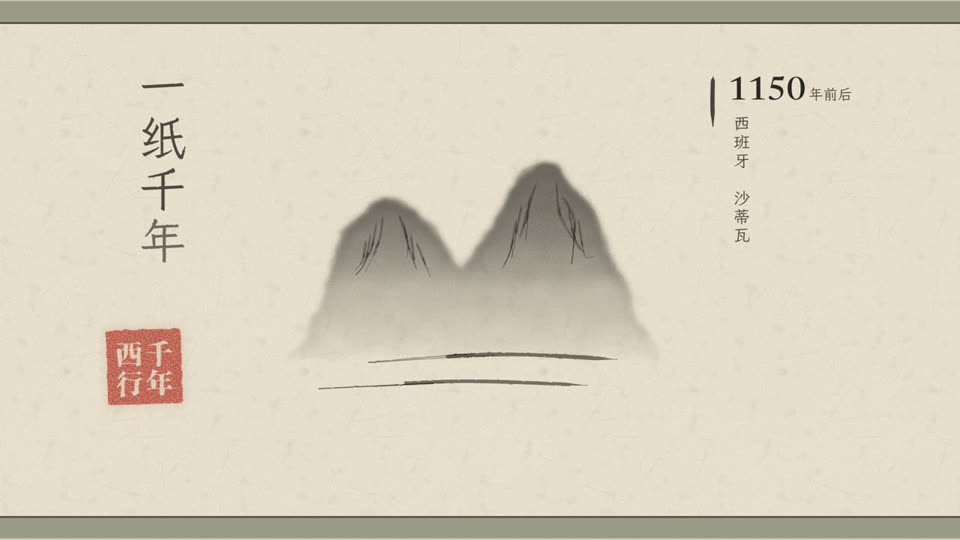
A Chinese handscroll read leftwards: places and people bloom out of wet ink and settle in layered tones, dates are inscribed in columns, a red seal marks the conclusion. Time is the scroll's length. For Chinese narration.
Essence, and what it is not
- One long strip of warm rice paper between silk mounting bands. The view travels along it from right to left, as a handscroll is read, and time moves with it.
- Masses are wet washes, never outlines: a range, a city or a crowd blooms from the point the brush touched, its edge feathered on the fibres with a darker tide line just inside, and a second, deeper tone soaks in after.
- Ink in five tones and nothing else, plus one vermilion: the seal. Far is pale, near is dark.
- Words are written on the painting in columns, right to left; a date is a short dark stroke on the line of time.
- What is painted stays on the scroll, which can be seen whole at the end.
Not lab-notebook (no lines drawn on a page, no grid: here a mass is a wash), not red-pencil (nothing is printed or marked up; red is a stamp, never a line), not a red paper-cut, not a cartoon (no outlines filled with flat colour, no faces).
Ground and material
The handscroll (react/parts/scroll.tsx) is the ground of every scene: paper in panel with tooth, pulp flecks, fibres and a slow clouding, between silk bands in border. Everything painted sits in a Place on the strip and dissolves into the paper as it nears the frame's edge, so the frame never cuts a painting. Ink is opacity on paper, never a grey fill: parts/ink.ts holds the tones, the stroke outline and the bristle tracks of flying white.
Colour roles
panel— the paper;panel2— aged paper;bg— the table around the scroll when it is unrolled or seen whole;border— the silk bands.text— ink, used only at the five tones: clear 0.16 (far hills, mist), light 0.34 (washes), heavy 0.58 (second tones, places), thick 0.8 (contours, figures), burnt 0.95 (inscriptions, dates).grad— vermilion, the seal and nothing else: never a wash, a line or a word.op(ochre) anddata(indigo ink): a pale tint on one subject at most; most films use neither.
Type and captions
Chinese is written in LXGW WenKai (display, as the inscriptions: titles 88 to 110 px in vertical columns, places 30 to 40 px, a smaller signature column at about 0.4 of the title). Figures and Latin are Newsreader with old-style numerals, 56 to 72 px for a year. Body text and the caption are Noto Serif SC. The caption is ink on the paper with no box: 42 px, weight 500, held off the painting by a soft halo of paper colour, the way a line of text sits in the blank at the foot of a painting.
Motion
Things are painted into existence, never slid or scaled in: a wash blooms over 1.5 to 2 s (ease-out), its second tone settles over about 1.5 s; a figure is painted robe, contour, head; characters soak in, soft then sharp. The view travels 2 to 3 s (ease-in-out) on the word that moves the story on, and holds while a place is painted. The seal presses in half a second with a slight overshoot. Nothing bounces, spins or flies.
Composition and framing
60 to 75 % of the frame is blank paper, water or mist. A stop's subject sits in the middle third, its date hangs from the top as a column, the road runs low above the caption; nothing rests within 160 px of the frame's sides. Between ideas the view travels, never cuts. The summing-up is the scroll pulled back whole.
Sound
Optional and quiet: paper rasping as the scroll unrolls, a soft wooden press for the seal, at most a sparse plucked string well under the narration.
Components
- close — Seal (
react/parts/seal.tsx): A square vermilion seal pressed on the word that concludes: carved characters, uneven paste, a faint bleed of red. Fits: the verdict or the moral of the story; the one figure the film was about; the end of the scroll, once - data — Era mark (
react/parts/era.tsx): A date on the line of time: a short dark stroke, the year in figures and the place in a column below. Fits: each stop of a history or a journey; a reign, a founding, an invention - ground — Handscroll (
react/parts/scroll.tsx): A long strip of rice paper between silk bands, unrolled from the right and travelled leftwards as time moves on. Fits: every scene: a history, a journey or stages laid out on one painting; seen whole as the summing-up - link — Brush stroke (
react/parts/brush.tsx): One stroke of a loaded brush: pressed in, swelling, tapering, its dry end breaking into flying white. Fits: a road, a river or a trade route between places; a pine trunk; one decisive line - quote — Figure (
react/parts/figure.tsx): A person in a few strokes: a pale wash for the robe, loaded strokes for its contour, dark ink for the head. Fits: the person a story turns on; a traveller on a road; small against the hills, never a portrait - steps — Ink wash (
react/parts/wash.tsx): A mass of wet ink (hills, a bank, a city) that blooms from one point with feathered edges and a tide line, then settles a deeper tone. Fits: a place coming into the story; land or a crowd as a mass; far hills in clear ink behind near ones - title — Inscription (
react/parts/inscription.tsx): Words written on the painting in columns, right to left, each character soaking in as it is written. Fits: the title of the scroll; a name or a place where it is painted; a line worth keeping
Native moves
- The ink blooms. A place or a people arrives as a wet wash spreading from one point, then settles a deeper tone. Fits content like: a capital founded; a kingdom's lands; a crowd gathering in a square.
- The scroll unrolls. The roller crosses the frame from the right and the paper opens behind it, then the view travels leftwards from stop to stop as the years pass. Fits content like: a dynasty's rise and fall; a journey along a road; an idea passed from teacher to pupil.
- The road is painted. One brush stroke, a few joined strokes for a long way, follows the story from place to place, wet where it starts and breaking into flying white. Fits content like: a trade route; a river's course; a pilgrim's way.
- The seal is pressed. A square of carved vermilion is stamped on the word that concludes, under the inscription that states it. Fits content like: the moral of a fable; the verdict of history; the date a thing became what it is.
- The whole scroll. The view pulls back until the strip is seen end to end, its dates written large beneath it. Fits content like: a thousand years in one look; how far a word travelled; every stage of a craft at once.
Avoid: pitfalls
- A wash with hard, clean edges reads as vector art. Fix: let it bloom from a point, keep its feathered edge and tide line, and give it a second tone.
- Too many dark masses: the paper stops breathing. Fix: one heavy mass per stop, the rest clear or light.
- A painting cut by the frame's edge. Fix: place it so it rests at least 160 px inside;
Placefades what comes closer. - Red on anything but the seal: it stops meaning "this is the conclusion". Fix: one seal per film, on the verdict.
- Dry strokes like dashed lines. Fix: let the bristle tracks break on long-scale noise, more towards the stroke's end.
- Long sentences written on the painting. Fix: inscriptions are titles, names and dates; the narration carries the sentences.
Freedom in each work
Each film decides its story, the scroll's length, which places bloom, whether people appear, what is inscribed, what the seal says and whether the scroll is seen whole. Three far-apart structures: a single journey from one end of the scroll to the other; a life told in four seasons, the same mountain painted four times as the view travels; an idiom told as a fable in three scenes, then its meaning inscribed and sealed.