
 Remotion
 HyperFrames
A printed page that is being read critically: the type is set and calm, and a red pencil works over it as the narration speaks, circling, striking, correcting and writing verdicts in the margin. The print states; the pencil judges.
Essence, and what it is not
- One printed sheet on a desk, with a running head, a text column and a margin. Everything stated is printed on it.
- The red pencil is the narrator's judgement. It is the only hand on the page and the only red.
- Marks are drawn as they are said: a circle closes on the word, a strike crosses the figure as it is called wrong.
- Corrections stay visible: the wrong figure is struck, never erased, and the right one is written beside it.
Not a newspaper front page (no columns of body text, no photographs as decoration), not a whiteboard (nothing is drawn from nothing: the pencil only marks what is printed), not a spreadsheet (a ledger is a few rows a reader can hold).
Ground and material
page.tsx draws the ground: a warm sheet (panel) with faint fibres and a soft shadow, on a darker desk (bg) that shows above, below and at its sides. The sheet ends above the caption band; the caption sits on the desk. PAGE in that file gives the text column (x 176 to 1360) and the margin (x 1440 to 1760): printed matter goes in the column, the pencil's notes in the margin. Print is flat and sharp; the pencil has a grain (a second, lighter pass beside each stroke) and never a perfect line.
Colour roles
text: printing ink. All printed words and figures.grad(red pencil): the narrator's mark. Circles, strikes, corrections, margin notes.badis the same red on purpose: in this motion a wrong figure and a judged one are the same act.warn: the highlighter, only as a translucent fill behind printed text (multiply), at most one row at a time.data: a second printing ink, for a printed chart's bars or lines.muted: running heads, labels in small capitals, units in italic.
Red is never used for print, and nothing printed is coloured for emphasis: emphasis is the pencil's.
Type and captions
Newsreader (sans here is the serif) for everything printed: headlines 72 to 96 px at weight 600, figures 140 to 200 px with lining tabular numerals, rows 40 to 48 px, small capitals 22 to 26 px letter-spaced. Caveat (display) is the pencil's hand: 48 to 72 px, weight 600 to 700, always red. Chinese: Noto Serif SC prints, LXGW WenKai writes. The caption is a printed slip on the desk with a red rule at its left: serif, 36 px, ink on paper.
Motion
Print arrives as print does: it is there, or it appears in place in under 0.3 s (no slides, no bounces). Rows of a ledger are printed one at a time on their words. The pencil moves at a hand's pace: a circle in 0.7 to 1 s, a strike in 0.3 to 0.5 s, a note written left to right at about 0.15 s a word. Pencil strokes ease in and out (easeInOutSine); writing is linear. Nothing printed moves once placed; the page never moves.
Composition and framing
The page fills the frame and stays: scenes change what is printed on it, not where the page is. One printed thing leads each scene and takes the left of the column at a large size; the margin is empty until the pencil has something to say. A frame with only a headline is not finished: the thing the headline is about is printed under it within the line. Leave a quarter of the column empty for the marks to land in.
Sound
Optional: a short dry pencil scratch under a strike or a circle, low in the mix. No music bed is part of the motion.
Components
- compare — Ledger (
react/parts/ledger.tsx): Printed rows with dotted leaders and figures in one column, a ruled total, and a highlighter pass over the row that matters. Fits: what a price is made of; fees that add up; two plans line by line - data — Printed figure (
react/parts/figure.tsx): One quantity set large in the page face, with its unit and a small-capitals line saying what it counts. Fits: the price as advertised; the total a reader is meant to remember; a number the pencil is about to question - ground — Printed page (
react/parts/page.tsx): The sheet everything is printed on: a running head, a text column and a margin for the pencil, lying on a darker desk. Fits: every scene; a new section changes the running head, not the page - mark — Correction (
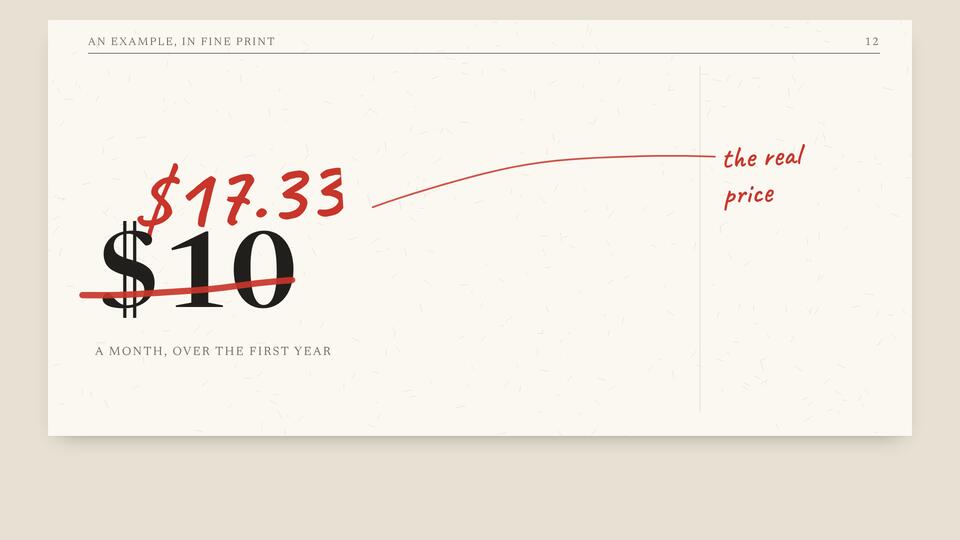
react/parts/correction.tsx): A printed figure struck through in red, and the right one written by hand above it. Fits: a total that was added wrong; the price as advertised against the price as paid; an estimate the evidence revises - mark — Pencil mark (
react/parts/pencil.tsx): A red-pencil circle, underline, box, tick or cross, drawn stroke by stroke as the narration questions what is under it. Fits: circling the figure that matters; underlining the clause that decides; ticking what holds and crossing what does not - quote — Printed excerpt (
react/parts/excerpt.tsx): A passage set as quoted print with its source, the phrase that decides underlined in red as it is read. Fits: the clause of a contract; the sentence of a rule or a report; what an advert actually promises - term — Margin note (
react/parts/note.tsx): A few words written by hand in red in the margin, with a pencil leader running back to what they are about. Fits: the verdict on a printed claim; the word a reader should take away; what the fine print really means - title — Printed headline (
react/parts/headline.tsx): A kicker, a serif headline and a one-line standfirst, set as a page sets them, before the pencil gets to them. Fits: the question a film checks; the claim a section is about to test
Native moves
- Circle the claim. The figure as printed is circled while the narration doubts it. Fits content like: a headline rate; a price before fees; a "best" in an advert.
- Strike and correct. The printed figure is struck, the right one written above it. Fits content like: a total added wrong; a forecast against the outcome; a nominal amount against the real one.
- Print the sum. Rows appear one per word, a double rule, then the total, then a highlighter pass over it. Fits content like: what a price is made of; costs over a year; two plans line by line.
- Quote the clause. The passage is printed as an excerpt with its source, and the phrase that decides is underlined in red on its words. Fits content like: a contract's fee clause; the line of a rule that sets a limit; the small print of an offer.
- Verdict in the margin. A few words in red in the margin, with a leader back to what they judge. Fits content like: what the fine print means; the condition that changes the answer; the one word to remember.
Avoid: pitfalls
- Red used for printed emphasis: the pencil stops meaning anything. Fix: print in ink, mark in red.
- A mark drawn before its word: the viewer reads the verdict before the reason. Fix: anchor the stroke's tween on the word that judges.
- A margin note that says what the narration says: it is noise. Fix: write the conclusion, in three words or fewer.
- Many marks at once: a marked-up page reads as a mess. Fix: at most two pencil marks visible in a scene; the earlier ones may leave with their scene.
- Handwriting for anything long: Caveat at body length is hard to read. Fix: print it.
Freedom in each work
Each film decides its story, scenes, which printed things and which marks, how many pages, the running head and the ending. Three far-apart structures: a claim checked line by line until the true figure is written; two printed offers compared, one struck; a rule read clause by clause with the decisive clause underlined.